
After the inspection in the DRC, who verifies the fix?Après une inspection en RDC, qui vérifie la correction ?
A field guide for Congolese provincial teams turning inspection findings into corrective actions that someone can independently check.Comment une équipe provinciale congolaise peut passer d’un constat d’inspection à une action corrective dont la clôture est vérifiable.
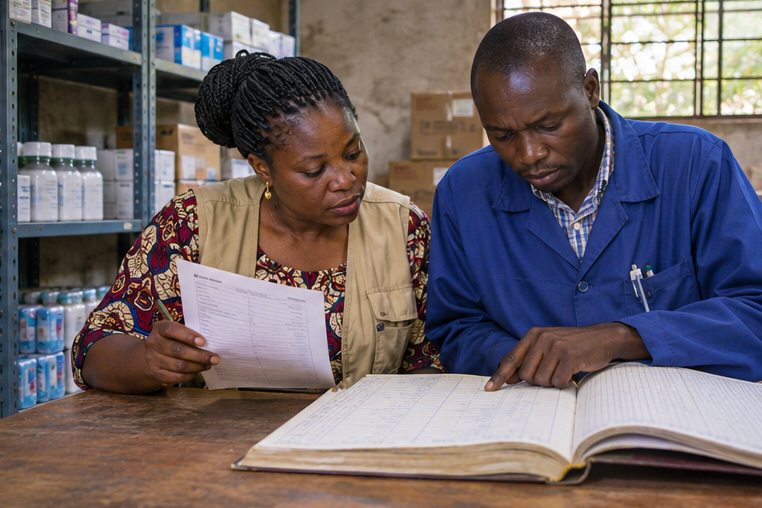
Consider a provincial store in the Democratic Republic of the Congo. An inspector finds three delivery notes that nobody can match to the stock register. At the follow-up meeting, the store reports “register updated”. What would let the inspector close that finding with confidence? Agreeing on the evidence at the first visit saves both parties a second round of correspondence.
Give the action a test before giving it a deadline
Create one action linked to the inspection, the site and the three delivery references. Name a storekeeper responsible for the correction and a separate reviewer authorised to close it. Agree on what the reviewer must see: for each delivery, its stock entry, quantity, date and an explanation for any remaining difference. Give the storekeeper a due date and a way to record a missing document without declaring the action complete.
The storekeeper submits the evidence. The reviewer accepts it or returns it with a precise reason. Preserve the first submission and the decision when a revised document arrives. In a shared weekly summary, show the site, action, due date and status. Keep supporting documents that identify individuals available only to the people examining the case.
Make the next review meeting shorter
Open the meeting with overdue actions that have no evidence, then show actions waiting for a reviewer. They have different owners. Try this on ten findings and count how many a reviewer can verify without calling the store. For recurring discrepancies, inspect the next delivery as well. Correcting three entries clears the immediate backlog. Seeing a new delivery entered correctly helps establish whether the process itself has improved.
For a real example of the reporting context, the DRC’s Cour des comptes publishes provincial control reports. The warehouse exercise above is illustrative and can be run with sample delivery notes before a team uses its own records.
Dans un magasin provincial en République démocratique du Congo, imaginons qu’un inspecteur relève trois bons de livraison introuvables dans le registre de stock. À la réunion de suivi, le magasin répond « registre mis à jour ». De quoi l’inspecteur a-t-il besoin pour pouvoir clore le constat ? S’entendre sur les justificatifs dès la visite évite un nouvel aller-retour de courriers.
Fixer le critère de clôture avant l’échéance
Ouvrez une action rattachée à l’inspection, au site et aux trois références de livraison. Désignez le magasinier chargé de la correction et une autre personne habilitée à valider la clôture. Convenez des pièces à produire pour chaque bon : la ligne du registre, la quantité, la date et l’explication de tout écart résiduel. Donnez au magasinier une échéance et le moyen de signaler une pièce manquante en laissant l’action ouverte.
Le magasinier transmet ses justificatifs. Le vérificateur les accepte ou les renvoie en indiquant précisément ce qui manque. Lorsqu’une nouvelle pièce arrive, conservez le premier envoi et la décision correspondante. Pour la réunion hebdomadaire, partagez le site, l’action, l’échéance et son état. Réservez les pièces nominatives aux personnes qui instruisent le dossier.
Raccourcir la prochaine réunion de suivi
Commencez par les actions en retard sans justificatif, puis passez aux dossiers en attente de vérification. Les personnes à relancer ne sont pas les mêmes. Faites l’essai sur dix constats et comptez ceux qu’un vérificateur peut clore sans rappeler le magasin. Si un écart se répète, examinez aussi la livraison suivante. Rectifier trois écritures résorbe le retard. Retrouver la prochaine livraison correctement enregistrée permet de juger si la pratique a changé.
Pour situer cet exercice dans son contexte, la Cour des comptes de la RDC publie des rapports de contrôle provinciaux. Le cas du magasin est fictif et peut se tester sur des bons de livraison d’exemple avant de passer aux dossiers de l’équipe.