
Can a coffee buyer trace a split lot back to the mill?Peut-on remonter d’un sac de café au lot dont il provient ?
For Ugandan coffee cooperatives, a shipment split between two buyers is a good first test of a digital traceability system.Pour une coopérative ougandaise, un lot réparti entre deux acheteurs constitue une bonne épreuve de traçabilité.
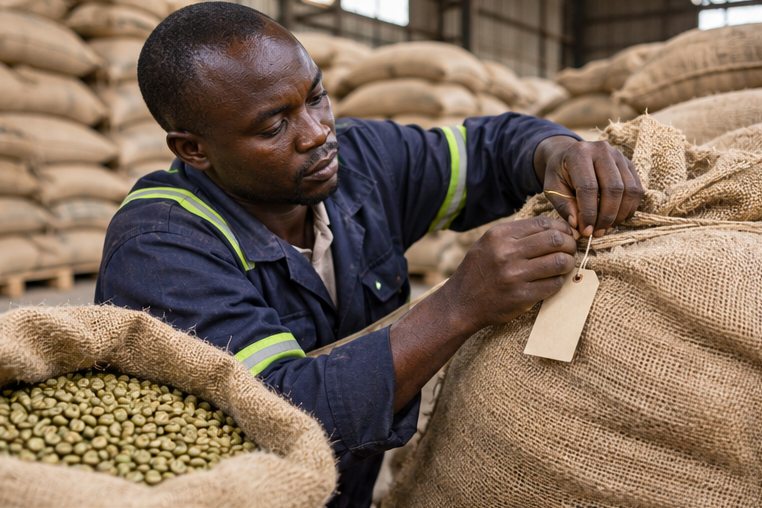
At a dry mill in Uganda, consider a lot of 30 numbered bags of green coffee. Eighteen go to one buyer and twelve to another. A week later, the second buyer asks which milling run produced bag 24. A scan that displays only the cooperative’s name cannot answer. The mill needs a record of where that bag came from and where the other bags in its lot went.
Make the split visible
Give the milling run a lot reference and link it to the intake lots that went into it. At packing, record the bag numbers, net weights and packing date. When the truck is loaded, create two dispatch records against the same parent lot. Each dispatch should list the bags that actually left, the recipient and the person who confirmed handover. A short delivery or damaged bag gets its own entry so the numbers still add up.
GS1’s traceability standard organises this information around events such as receiving, transforming and shipping goods. A cooperative can test the idea with numbered labels and a shared register. Ask the buyer to pick a bag at random and send its number. Time how long the mill takes to identify the run, its intake records and the destinations of the remaining bags.
Decide whether partners need a shared ledger
A single mill can keep this register in a database it controls. A shared ledger becomes worth investigating when independent partners need to record their own handovers and disagree about who may amend them. Before funding that work, ask the mill, transporter and buyer to agree on one correction procedure. Even a tamper-evident history will faithfully preserve a wrong weight until someone spots it and records the correction.
Dans une usine de décorticage en Ouganda, prenons un lot de 30 sacs numérotés de café vert. Dix-huit partent chez un acheteur, douze chez un autre. Une semaine plus tard, le second veut connaître l’origine du sac 24. Si le code scanné affiche seulement le nom de la coopérative, la question reste entière. Il faut retrouver la série de décorticage et savoir où sont partis les autres sacs.
Enregistrer la répartition du lot
Attribuez un numéro à la série de décorticage et rattachez-y les lots entrés à l’usine. À l’ensachage, consignez les numéros des sacs, leurs poids nets et la date. Au chargement, établissez deux bons de sortie reliés au même lot d’origine. Chacun précise les sacs effectivement livrés, le destinataire et la personne qui a confirmé la remise. Notez séparément un sac abîmé ou manquant pour pouvoir expliquer l’écart.
Le standard de traçabilité de GS1 organise les données autour d’événements tels que la réception, la transformation et l’expédition. Des étiquettes numérotées et un registre partagé suffisent pour un essai. Demandez à l’acheteur de choisir un sac au hasard. Chronométrez le temps nécessaire pour retrouver sa série, les apports qui la composent et les destinataires des autres sacs.
Décider si un registre distribué se justifie
Une usine peut tenir ce registre dans sa propre base de données. Un registre distribué mérite examen lorsque plusieurs partenaires indépendants veulent consigner leurs remises et s’interrogent sur le droit de modifier l’historique. Avant d’y investir, demandez à l’usine, au transporteur et à l’acheteur de convenir d’une procédure de rectification. Un registre qui garde la trace de chaque modification conserve aussi une pesée erronée tant que personne ne la détecte et ne la corrige.